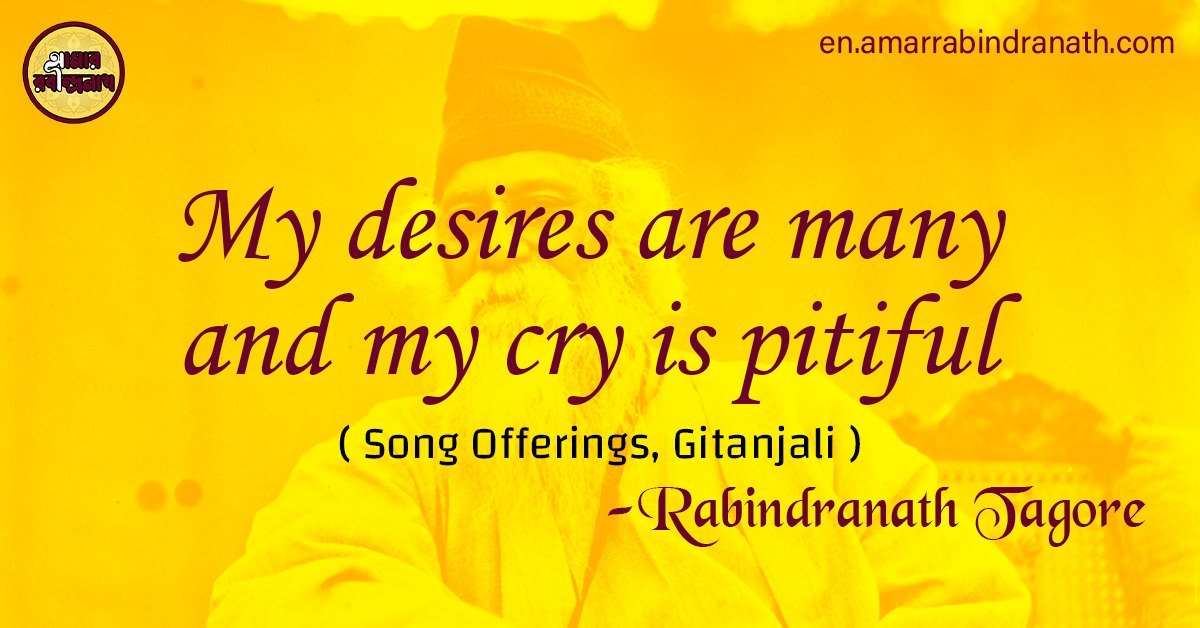
My desires are many and my cry is pitiful – is a poem in the Rabindranath Tagore’s poetry collection “Song Offerings” or “Gitanjali” in Bengali. Geetanjali is a remarkable book of verses composed by Rabindranath Tagore (1861-1941), which earned him the Nobel Prize.
![AmarRabindranath.com Logo 252x68 px White My desires are many and my cry is pitiful by Rabindranath Tagore [ Song Offerings, Gitanjali ]](https://en.amarrabindranath.com/wp-content/uploads/2023/01/AmarRabindranath.com-Logo-252x68-px-White.png "My desires are many and my cry is pitiful by Rabindranath Tagore [ Song Offerings, Gitanjali ] 2")
Serial Number of the song : 14
My desires are many and my cry is pitiful.
MY DESIRES ARE many and my cry is pitiful,
but ever didst thou save me by hard refusals,
and this strong mercy has been wrought into my life through and through.
Day by day thou art making me worthy of the simple, great gifts that thou gavest to me unasked-this sky and the light,
this body and the life and the mind-saving me from perils of overmuch desire.
There are times when I languidly linger and times when I awaken and hurry in search of my goal;
but cruelly thou hidest thyself from before me.
Day by day thou art making me worthy of thy full acceptance by refusing me ever and anon,
saving me from perils of weak, uncertain desire.
“My desires are many and my cry is pitiful” is a profound poem written by Rabindranath Tagore, a renowned Indian poet, philosopher, and polymath. The poem speaks about the human condition of being trapped in the cycle of desire, and the sense of futility and desperation that comes with it.
The poem begins with the speaker acknowledging the abundance of desires that they possess. They describe their desires as being numerous and diverse, ranging from material possessions to intangible aspirations such as love and fame. However, despite having so many desires, the speaker feels that they are unable to attain any of them. They cry out pitifully, expressing their frustration and desperation.
The second stanza of the poem deepens the sense of despair felt by the speaker. They describe themselves as being like a bird trapped in a cage, unable to fly freely and fulfill their desires. They lament their fate and wonder why they are trapped in this way. The speaker also acknowledges that they are not alone in their suffering, and that many others are similarly trapped.
In the third stanza, the speaker reflects on the transience of life and the inevitability of death. They compare their desires to bubbles that burst and disappear quickly, leaving behind nothing. The speaker acknowledges that their desires are fleeting and ultimately meaningless in the face of death.
The final stanza of the poem offers a glimmer of hope amidst the despair. The speaker acknowledges that while their desires may be futile, there is still something worthwhile to strive for – the pursuit of truth and beauty. They describe these as being eternal and everlasting, in contrast to the fleeting nature of desire. The speaker encourages others to pursue these higher ideals, even as they struggle with their own desires.
In conclusion, “My desires are many and my cry is pitiful” is a powerful poem that speaks to the universal human experience of desire and despair. Through his lyrical and poignant language, Tagore captures the complexity and depth of this experience, and offers a message of hope amidst the darkness.
1 thought on “My desires are many and my cry is pitiful by Rabindranath Tagore [ Song Offerings, Gitanjali ]”