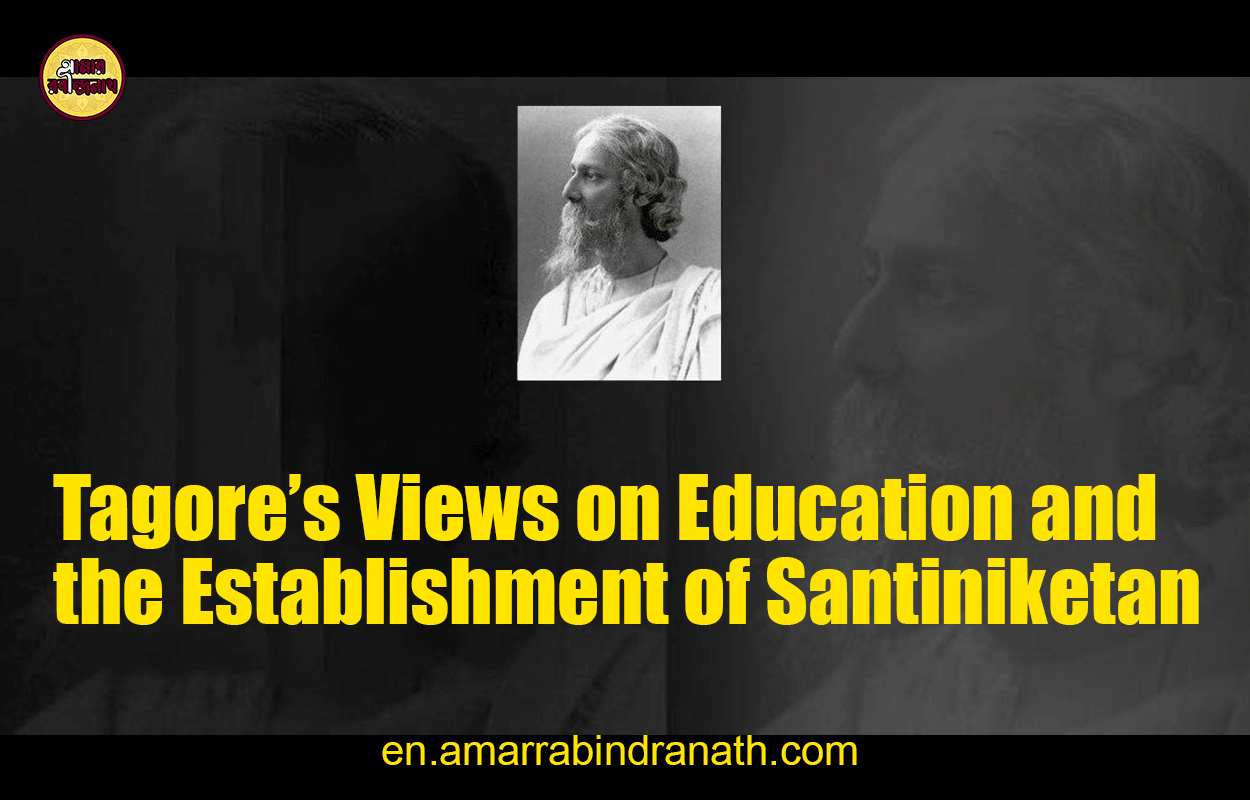
Rabindranath Tagore, a multifaceted figure in the annals of Indian culture, was not just a poet and musician but also a visionary educator. The Nobel laureate, often referred to as the “Bard of Bengal”, harbored distinct views on education. These views found their most beautiful and practical expression in the establishment of Santiniketan. To understand the institution and its significance, it is crucial to delve into Tagore’s philosophy on education and the innovative approach he championed.
Table of Contents
The Genesis of Tagore’s Educational Philosophy
Tagore’s views on education evolved from a personal disdain for the conventional methods used in schools and colleges during his time. As a child, he found these methods suffocating and rigid. In his own words, he described traditional schools as “a monstrous storage of facts and disciplines”. He felt that real education was beyond mere information—it was about fostering creativity, moral integrity, and a love for nature and life.
His experiences abroad, especially in countries like Japan and the USA, further influenced his thoughts. Tagore was deeply inspired by the natural environment, spiritual ethos, and the cultural aesthetics he witnessed, which led him to envisage an education system that was deeply rooted in one’s surrounding and culture yet open to the winds of global thoughts.
Basic Tenets of Tagore’s Philosophy on Education
- Holistic Development: Tagore believed that education should cater to the all-round development of a child—physical, intellectual, and spiritual. He was of the view that true education enabled a person to achieve a harmonious balance of these elements.
- Learning from Nature: For Tagore, the world of nature was the best classroom. He felt that a direct communion with nature nurtured creativity and imagination in young minds.
- Learning through Joy: Tagore propounded the idea that learning should be a joyous activity. He opposed the rote learning method prevalent in his time and believed that education should be driven by the child’s innate curiosity.
- Integration of Art and Education: He felt that art, music, and dance were not mere subjects to be studied but essential elements of a holistic education that helped in expressing one’s deepest feelings and understanding the world better.
- Global Perspective: While Tagore believed in the importance of being rooted in one’s culture, he also argued that students should be exposed to global ideas and thoughts. He envisioned a world where walls between nations and cultures crumbled through mutual respect and understanding.
Santiniketan: A Beacon of Tagore’s Educational Vision
Santiniketan, meaning the ‘abode of peace’, was Tagore’s earnest attempt to translate his educational ideals into reality. Established in 1901, Santiniketan was more than just a school—it was an embodiment of Tagore’s dream of a place where the mind is free, and education flows naturally.
Natural Environment: Located amidst the serene settings of Birbhum in West Bengal, India, Santiniketan was surrounded by trees, meadows, and a tranquil ambiance. Classes were often conducted under the trees, allowing students to feel a direct connection with nature.
Curriculum: The curriculum at Santiniketan was a rich blend of traditional Indian arts, western education systems, and universal values. While students learned subjects like history, mathematics, and the sciences, they also received training in arts, crafts, music, and dance.
Visva-Bharati University: Later, Santiniketan grew into Visva-Bharati University, which attracted students from all corners of the world. This institution aimed at promoting the study of India’s rich cultural heritage while also integrating the best of western education.
Emphasis on Individual Growth: Tagore believed that every individual had a unique rhythm. In Santiniketan, emphasis was placed on individual growth and self-development rather than competition. Teachers were more mentors, guiding students on their personal educational journeys.
Legacy and Influence
Tagore’s experiment with education was both innovative and influential. Santiniketan’s model was a testament to an education system that was deeply Indian yet global in its approach.
Many luminaries across various fields, both from India and abroad, visited Santiniketan and were deeply influenced by its philosophy. Some prominent figures include the famous sculptor Ramkinkar Baij, filmmaker Satyajit Ray, and Indira Gandhi, the former Prime Minister of India.
Santiniketan also forged international connections. It welcomed renowned personalities like the Japanese painter Yokoyama Taikan and the American historian Will Durant.
Conclusion
Rabindranath Tagore’s philosophy on education was a beacon of hope during a time when India was struggling under colonial rule. His emphasis on a holistic, nature-driven, and joyous method of education was revolutionary. Santiniketan, as a manifestation of his ideals, stands not just as an educational institution but as a symbol of an education system that bridges the traditional with the modern, the local with the global.
Today, as the world grapples with the challenges posed by mechanized learning and digitization, revisiting Tagore’s views on education can provide insights and inspirations. Santiniketan, with its ethos of holistic learning and global brotherhood, remains relevant, reminding us of the true purpose and potential of education.