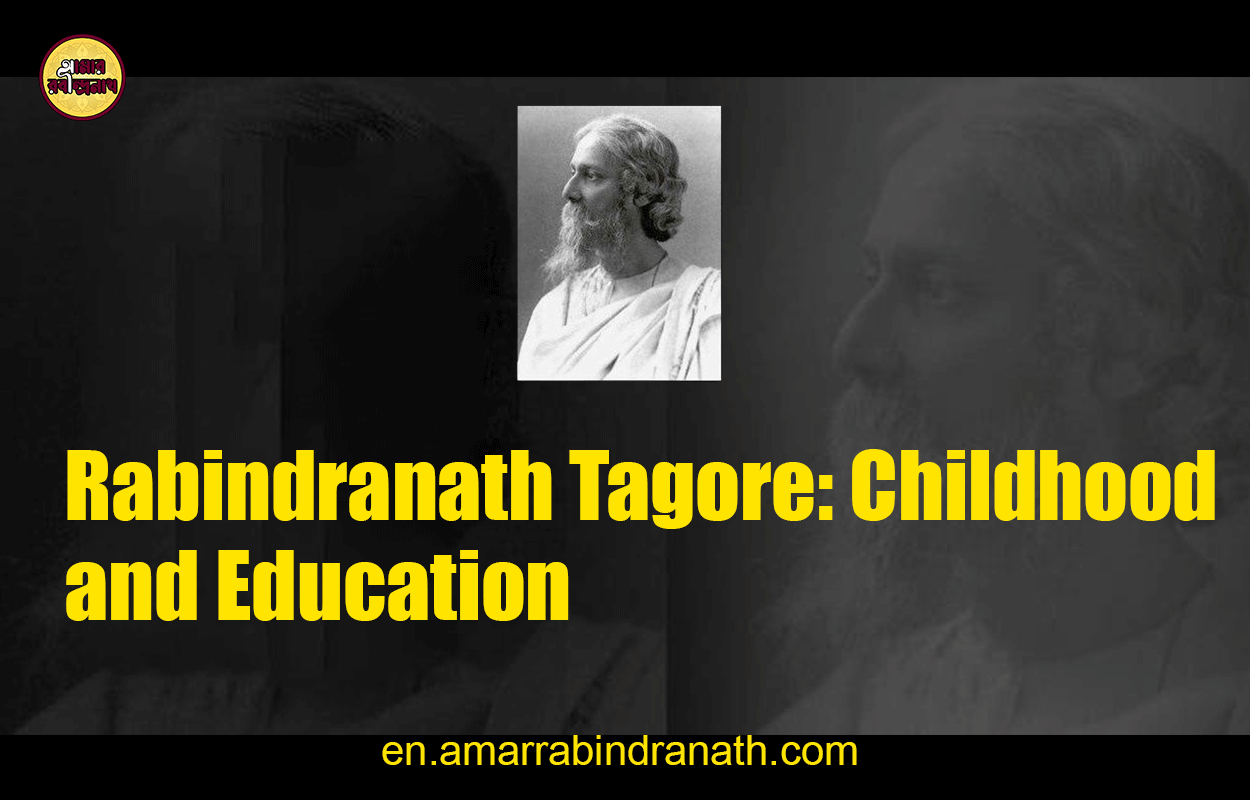
Rabindranath Tagore, renowned as the “Bard of Bengal,” is a towering figure in the pantheon of world literature. Known primarily for his poetry, songs, stories, and essays, Tagore was also a painter, philosopher, and educationist. He remains the only poet to have penned the national anthems for two countries – India and Bangladesh. Before he reached such pinnacles, he traversed a fascinating journey of childhood and education that greatly influenced his worldview and artistic expressions.
Table of Contents
Early Life
Rabindranath was born on 7th May 1861, in the vibrant city of Calcutta (now Kolkata) into the wealthy and illustrious Tagore family of the Jorasanko mansion. The Tagores were deeply involved in arts and culture, and their abode was a bustling hub of cultural activity, music, literature, and theater.
His father, Debendranath Tagore, was a leading figure in the Brahmo Samaj, a religious and social movement that sought to reform Hinduism. His mother, Sarada Devi, was a nurturing force, though Rabindranath lost her at a tender age.
Growing up in such an environment, Rabindranath was exposed to a blend of classical Indian traditions and Western ideas. This multicultural upbringing would profoundly shape Tagore’s worldview and make him a bridge between the East and the West.
Education at Home
Rabindranath’s formal education began in the conventional settings of Calcutta’s schools. However, he did not find the rigid structure and rote-learning methods appealing. The confining walls of the classroom stifled his creative spirit, prompting his family to opt for home tutoring.
At home, Tagore studied a diverse array of subjects, ranging from Sanskrit classics to English literature. His educators included some of the finest scholars of the time, ensuring that his foundation in both Indian and Western traditions was robust. His love for nature and the environment around him also became a classroom of sorts, a theme that would recur frequently in his works.
Travels and Further Studies
In 1878, at the age of seventeen, Rabindranath was sent to England to acquire a formal British education. He first enrolled at a public school in Brighton and later moved to London to study law at University College London. However, the structured environment of Western education didn’t resonate with him here either.
Though he didn’t complete his formal education in England, the nation’s literary and cultural environment had a profound influence on young Tagore. He became acquainted with English, Scottish, and Irish literature. Works by Shakespeare, Wordsworth, and the Romantics became a significant part of his literary diet.
The three years Tagore spent in England were crucial. They not only widened his literary horizons but also honed his sense of music. The exposure to Western classical music would later inspire him to introduce new musical forms and styles into Bengali music.
Santiniketan: Tagore’s Educational Philosophy
Upon returning to India, the experience and learning from both East and West amalgamated in Tagore’s mind, leading him to envision a new form of education. He realized the essence of education wasn’t just in books but in fostering creativity, critical thinking, and a close bond with nature.
With this vision, in 1901, Tagore established an open-air school at Santiniketan (Abode of Peace). Named ‘Patha Bhavana,’ this school was a manifestation of his educational philosophy. The classrooms were amidst nature, under trees, embodying the idea that learning should be in harmony with nature. The curriculum was a blend of traditional Indian and Western subjects. Art, music, and dance were integral to the learning process.
Santiniketan would later evolve into Visva-Bharati University, attracting scholars and artists from all over the world. It became a melting pot of cultures and ideas, reinforcing Tagore’s belief in the universality of knowledge and the interconnectedness of human civilization.
Conclusion
Rabindranath Tagore’s childhood and education were a blend of traditional Indian wisdom and Western modernity. His experiences, both at home and abroad, shaped him into a global thinker, far ahead of his times. By merging the best of both worlds, he crafted a unique educational philosophy, emphasizing holistic learning, creativity, and a close relationship with nature. In the process, Tagore not only transformed how education was perceived in India but also left an indelible mark on the world’s literary and philosophical landscape.