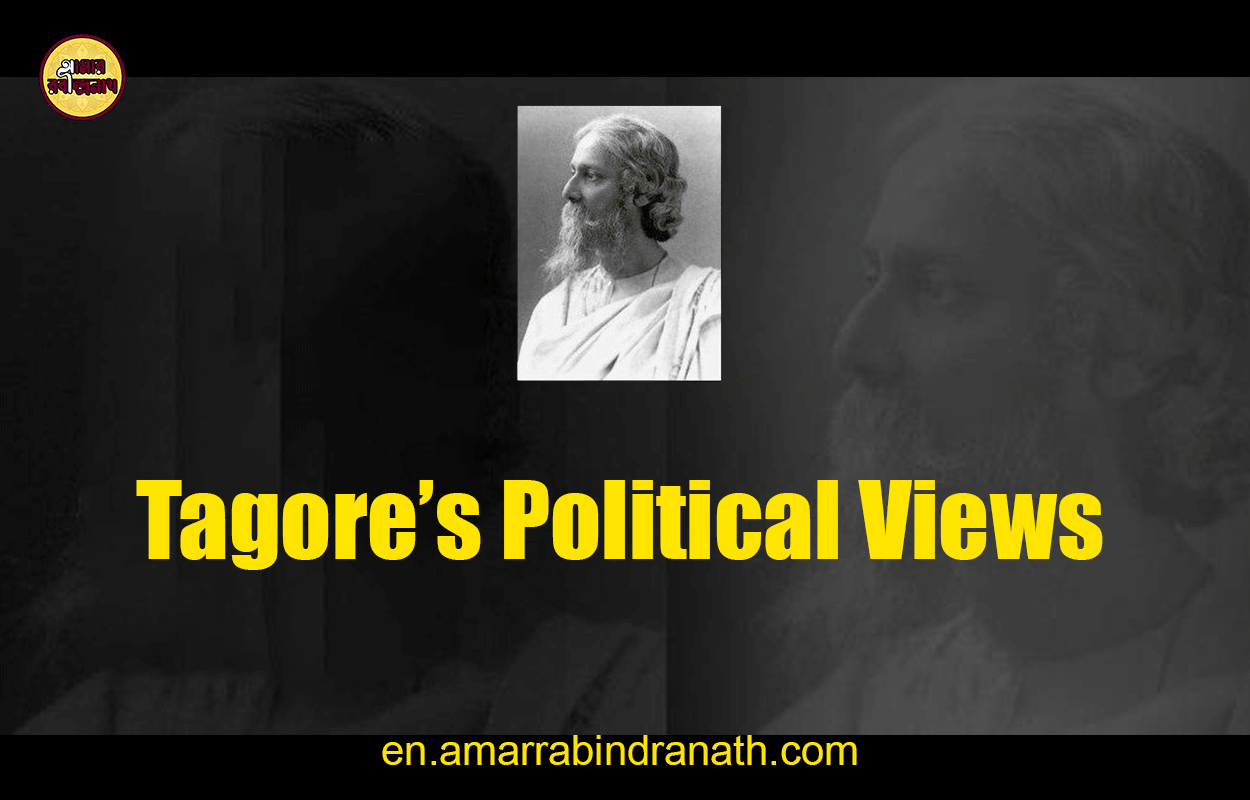
Rabindranath Tagore, the renowned Bengali polymath, is perhaps best remembered for his poetic genius, having penned the Indian national anthem and receiving the Nobel Prize in Literature in 1913. However, delving deeper into Tagore’s vast body of work reveals a visionary thinker who not only contributed significantly to literature, music, and art but also to the realm of politics, education, and social reform. This article aims to shed light on the political views of Rabore, highlighting their nuances, the underlying philosophy, and their contemporary relevance.
1. Overview:
Tagore’s political beliefs were not straightforward, and they often stood apart from the mainstream political ideologies of his time. He was neither a staunch nationalist in the conventional sense nor an apolitical artist. Instead, his philosophy was an amalgamation of deep spiritual beliefs, a humanistic approach to society, and a strong urge for world unity.
2. Critique of Nationalism:
- Universalism vs. Nationalism: One of Tagore’s most enduring and controversial positions was his critique of fierce nationalism. He believed that nationalism, particularly in its aggressive forms, was an instrument of division, alienation, and potential conflict. For Tagore, the ideal was a world where boundaries became irrelevant, and the spirit of universal humanity prevailed.
- World War I: Tagore’s skepticism about nationalism intensified during World War I. He viewed the war as a direct consequence of aggressive nationalistic fervor and was deeply distressed by the widespread destruction it brought.
- Resignation of Knighthood: His anti-nationalistic stance became evident when he renounced his knighthood in 1919 in protest against the Jallianwala Bagh massacre, a brutal act by the British colonial rulers against innocent Indian civilians. This act underscored Tagore’s profound commitment to humanistic values over symbols of colonial privilege.
3. Views on Freedom and Self-reliance:
- Spiritual and Political Freedom: Tagore’s concept of freedom transcended political boundaries. He believed in the spiritual liberation of the soul and the intellectual and moral growth of individuals. Such freedom, in his view, was the key to true national progress.
- Self-reliance: He promoted the idea of “Atmanirbharata” (self-reliance) long before it became a buzzword in Indian politics. He believed that self-reliance, especially in the rural economy, would pave the way for a more egalitarian society.
4. Education and Constructive Work:
Tagore’s vision for a free India rested heavily on education. He believed that education should not be confined to the traditional classroom but should encompass all aspects of life.
- Shantiniketan: His establishment of the Visva-Bharati University at Shantiniketan is a testament to his innovative educational philosophy. It was conceived as a place where the world could meet in a single nest, fostering a global perspective among students.
- Constructive Work: Tagore believed in the power of constructive work and its ability to bring about societal transformation. He encouraged hands-on experiences and vocational training to make education more holistic and relevant.
5. Views on Religion and Politics:
For Tagore, the intersection of religion and politics was problematic. He was a firm believer in the separation of these two realms.
- Religion as Personal: Tagore believed that religion was an intensely personal experience. He was critical of organized religion, especially when used as a tool for political mobilization.
- Against Communal Politics: He was deeply pained by the growing communal tensions in India and consistently spoke against divisive politics based on religious identity.
6. Critique of Western Civilization:
Tagore’s travels to various parts of the world gave him a unique perspective on Western civilization. While he admired its achievements, he was critical of its materialistic orientation.
- Loss of Moral Compass: He believed that the West had become overly materialistic, leading to a loss of moral and spiritual values.
- Colonial Exploitation: Tagore was critical of the Western colonial enterprise. He viewed colonialism as an extension of the West’s aggressive pursuit of material wealth, leading to the exploitation of colonized nations.
7. Contemporary Relevance of Tagore’s Political Views:
In today’s age of hyper-nationalism, increasing religious intolerance, and materialistic pursuits, Tagore’s political and social philosophies resonate profoundly.
- Global Unity: His call for global unity and understanding is especially relevant in an increasingly interconnected yet divided world.
- Humanism: His emphasis on humanistic values over narrow identities provides a much-needed perspective in today’s polarized political climate.
- Education: His views on holistic education, focusing on moral, intellectual, and vocational growth, provide a blueprint for educational reforms.
Conclusion:
Rabindranath Tagore’s political views were intricately woven with his spiritual beliefs, commitment to humanism, and vision for a unified world. While he may have been critiqued in his time for his skepticism towards fervent nationalism, his beliefs have withstood the test of time. In a world grappling with divisive politics, rising intolerance, and the challenges of globalization, Tagore’s vision offers a beacon of hope and a path towards a more inclusive, tolerant, and unified global community.